
In these videos, our experts break down wavelength division multiplexing to help you get the most from your fiber. We’re covering the following topics in our first set of bite-sized videos:

WDM Fundamentals
Wavelength division multiplexing (WDM) can help network operators stay ahead of growing demand for bandwidth. Read on to learn the fundamentals of this useful technology.
-
Question 1: What does WDM do?
In traditional fiber-based telecommunications, information is transmitted over dedicated fiber links using laser light sources. Light sources are based on common wide optical spectrum bands and are often referred to as ‘grey’ optics.
As the number of services and data rates increase for a link, a service provider has the choice to either add more fiber, or to use wavelength division multiplexing. In optical communications, WDM increases the capacity of a given fiber link by using light sources of specific narrow band spectrum or wavelengths for multiple services. These sources (transceivers) are often referred to as ‘colored’ optics.
By using the same fiber link for multiple service streams, savings can be realized vs. constructing or leasing new fiber paths.
-
Question 2. What exactly is WDM technology itself?
Multiple traffic channels can be assigned different wavelengths and then multiplexed (mixed) onto a fiber link with WDM filter devices. On the other end of the network, WDM filters will demultiplex (separate) the signals for the respective channels.
There are different filtering technologies such as thin film filters or arrayed waveguides, but their function is the same. WDM Multiplexers and Demultiplexers combine and separate different wavelengths (colors) of light signals on a common fiber connection. This WDM technology can significantly increase the capacity of limited fiber resources.
-
Question 3. What are the benefits of WDM in Optical Communications?
A major concern in today’s connected world is fiber exhaust, where the demands for fiber exceed the amount of available fiber in the network. The evolution of WDM technology can alleviate fiber exhaust, by requiring fewer fibers to transmit and receive multiple services.
By utilizing more wavelengths, the potential bandwidth capacity of a single fiber strand grows. Both wireless and wireline networks use WDM. From long haul to metro and local access networks, including FTTH, mobile backhaul and front haul. As these networks continue to converge, there is even more value to utilizing WDM in optical communications.
WDM At Home Learning
WDM At Home Learning
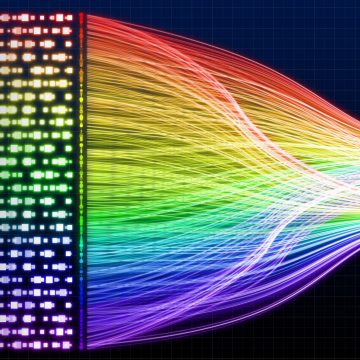
Arrayed Waveguide Grating
Arrayed Waveguide Grating, AWG, is one of two technologies used to mux and demux wavelengths. Here Corning’s Benoit Fleury discusses the technology behind the device.
Viavi Channel Verification
Viavi’s Mark Leupold takes a few minutes to review their latest channel verification tool OCC-4056C.
WDM – Just the Basics
The basics of wave division multiplexing as explained by Jason Morris at Corning. It’s as easy as driving a car!
Electromagnetic Spectrum Reviewed
Join David Kozischek (Koz) with Corning as he explains the electromagnetic spectrum creating a better understanding of wavelengths/channels utilized in WDM technologies.
Thin Film Filters 101
Thin Film Filter, TFF, is one of two technologies used to mux and demux wavelengths. Here Corning’s Benoit Fleury discusses the technology behind the device and explains why it’s the technology of choice when deploying WDM filters.
DWDM in the OSP
Here Mark Hess with Corning takes a few minutes to discuss DWDM filters as they are utilized in the outside plant.
Viavi DWDM OTDR
Viavi’s Mark Leupold takes a few minutes to review their Wavescan® technology and how it helps with tracing various channels.
Need Help with a WDM Solution Deployment?
Please briefly describe your wavelength management questions/needs in the comments section below. For example, CWDM vs. DWDM channel requirements, particular platforms, or general consultation.