Multicore Fiber Sustainability: Lower Carbon, Faster AI Data Center Builds | Corning

Analysis reveals how Corning® Multicore Fiber Solution can cut the carbon footprint of a data center’s passive optical infrastructure

Carly Gaj
Published: September 10, 2026

Power and cooling dominate the sustainability conversation in the data center industry — and for good reason. But as AI workloads scale, the physical infrastructure connecting all that compute is expanding just as quickly. It's quietly becoming an actionable place to cut carbon and improve AI data center sustainability.

At Corning, we wanted to quantify that opportunity. Our latest analysis suggests the passive optical layer alone can deliver up to a 60 percent reduction in embodied carbon per GPU by using technology that drops straight into existing designs for AI data centers.

Key Takeaways

What We Studied: Lifecycle Assessment of Multicore Fiber in AI Data Centers

In our latest whitepaper, we conducted a cradle-to-gate, third-party-reviewed lifecycle assessment on two AI data hall configurations supporting the same GPU footprint. One used traditional single-core fiber. The other used our new four-core Corning® Multicore Fiber. The scope covered optical fiber, cables, housings, trays, ducts, and packaging.

We were deliberate about the design. When you're running this kind of comparison, it's essential to manipulate only one variable — so we kept the compute footprint identical and focused the system boundary strictly on the passive optical layer. That way, bandwidth, latency, and compute capability never became trade-offs in the analysis.

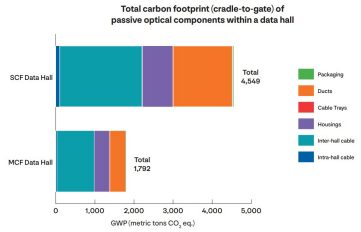
The results were striking. The single-core hall generated roughly 4,500 metric tons of CO₂ equivalent. The multicore hall came in just under 1,800 metric tons. Normalized per GPU, that's an up to 60 percent reduction. I discussed these results and much more in a Data Center Dynamics broadcast that you can watch here.

Multicore Fiber

Why AI Data Center Operators Need Higher-Density, Lower-Carbon Infrastructure

Ask any operator today where the pressure is greatest, and density tops the list. As GPU clusters grow, the physical space within the data center is becoming constrained — and that space gets exhausted before optical performance limits are reached.

Layer on a skilled labor shortage, aggressive project timelines, and mounting sustainability pressure, it becomes clear these challenges can't be solved in isolation. Operators need solutions that address several at once. That's the lens we brought to this study of passive optical infrastructure.

How Corning® Multicore Fiber Increases Density Without Redesign

Our multicore solution packs four cores inside the same 125-micron cladding used in traditional single-core fiber. That means you need fewer cables, fewer housings, less space consumed in trays and ducts, and a more compact footprint overall — with no compromise on bandwidth, latency, or compute capability.

Two misconceptions come up often, and both are worth addressing directly.

The first is that multicore requires a complete network redesign or is reserved for greenfield builds. It isn't. We designed our multicore fiber as a drop-in replacement for today's single-core fiber, compatible with existing cable designs and deployment practices in modern data centers.

The second is that higher density automatically increases operational complexity. What we found in our study is really the opposite. With fewer cables and connections, deployment and testing move faster.

Our modeling showed about a 60 percent reduction in passive optical installation and testing effort compared to single-core fiber. That translates into up to a nine-month reduction in cable installation and testing schedules for AI data center builds.

How Multicore Fiber Reduces Waste, Labor, and Installation Complexity

The material savings show up in less visible places too. Cable reels — a highly visible waste stream at AI scale — dropped from about 74 metric tons to 19 metric tons in our study. That's roughly a 74 percent reduction. Fewer reels mean less staging space required inside the data center, less handling, and less pressure on already stretched deployment teams.

Why Multicore Fiber Is a Practical Sustainability Solution Today

The most important detail for operators is this: these savings are something operators can realize today.

For operators looking to make sustainability improvements now — without waiting on future efficiency gains or major infrastructure overhauls — passive optical infrastructure has become one of the most immediate levers available. A single pull unlocks lower carbon, faster deployment, less space consumed, and reduced labor demand.

At AI scale, that combination is hard to ignore.

Are you interested in learning more about Corning® Multicore Fiber Solutions or GlassworksAI™? Fill out the form below to contact us and learn how Corning can help optimize your AI data center infrastructure.

Carly Gaj

Carly Gaj is Sustainability Program Director at Corning Optical Communications. With 15 years experience in sustainability and environmental science, Carly leads advancing sustainability across the business, including product sustainability, responsible business practices, environmental product compliance, and stakeholder engagement. She and her team support customers, suppliers, and internal partners in addressing sustainability opportunities related to decarbonization, responsible supply chains, regulatory compliance, product transparency, and sustainable innovation. Carly obtained her B.S. in Environmental Science from UCLA.

Interested in learning more?

Contact us today to learn how our end-to-end fiber optic solutions can meet your needs.

Thank you!

A member of our team will reach out to you shortly.