
Advance AI Networks and Scale Up AI Data Center Infrastructure | Corning Advanced Optics and Optical Communications

AI Thrives when Advanced Optics and Optical Fiber Combine

Benoit Fleury & Xavier Lafosse
Published: January 15, 2026

From Edison’s lightbulb to specialized smartphone glass and optical fiber, Corning glass innovations have helped shape how people connect, communicate and compute for nearly 175 years. Today, that legacy continues as Corning continues to develop the intricate technologies that enable and improve AI connectivity and advance the infrastructure that supports data-driven intelligence.

The future of AI is quickly unfolding, and glass innovations are key to keeping pace with unprecedented data demand.

Advanced optics and semiconductors: The foundation of advanced AI networks

Corning Advanced Optics division has a long-standing history of innovation. Over the last 50 years, Corning Advanced Optics has expanded its focus to include glass solutions for aerospace and defense, specialty glass, high-end optics production and technology, and semiconductor technology—developing materials that are critical to nearly every step of the chip building process.

The division also has a proven record of enabling three essential areas of chip manufacturing: photolithography (a patterning process that uses light to transfer a design from a photomask template onto a wafer substrate), inspection and metrology (the process of identifying defects and controlling accurate feature positions and critical dimensions), and advanced packaging (the process of assembling several chips together to build a complex system-in-package device). From cell phones and laptops to the AI accelerators GPUs that serve as the platform of AI networks, advanced optics play a significant role in capacity growth.

"AI’s rapid evolution hinges on breakthroughs in semiconductor manufacturing, and Corning Advanced Optics is proud to plays a pivotal role. Our glass materials and precision optical components enable the advanced chip building processes that power modern AI networks — from photolithography to inspection and advanced packaging,” said Xavier Lafosse, Commercial Technology Director, Advanced Optics & Precision Glass Solutions at Corning. “By collaborating across the semiconductor ecosystem, Corning helps deliver the scalable connectivity and processing performance required for next-generation AI applications."
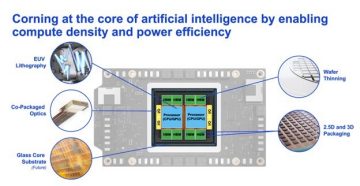

AO Chip

Powering AI growth through scale-up architectures

In today’s AI landscape, there’s a rising adoption of the “scale up” approach within AI data centers, where computational performance is boosted by adding more GPU resources within an existing AI network node.

The simplest way for a data center operator to scale up a GPU node is to increase the number of GPU accelerators among a given single node. Interconnecting these GPUs in the expanding cluster involves high-speed interconnects between network switches and the AI accelerators. As AI applications, like large language models, grow in size and complexity, this approach allows operators to incrementally add low-latency capacity to help ensure the node has enough network and memory bandwidth.

But scaling up also introduces new challenges. Scaling up is more than just adding GPUs. For one, the connections inside server boxes must accommodate denser configurations, tighter bends, and more compact routing paths. Traditional fiber isn’t a good fit for these extreme circumstances. Instead, specialized fiber strands, such as Corning® CPO FlexConnect™ fiber, engineered specifically for tight-bend performance and high reliability, are required to better support these dense internal architectures.

For these architectures to work, they need a physical infrastructure that’s forward-thinking, resilient, and capable of moving massive volumes of data at unprecedented speeds.

How advanced optical components unlock CPO

Another major shift in AI data center architecture is the emergence of co-packaged optics (CPO). Unlike traditional designs, where optical modules reside at the edge of a switch or server tray, CPO integrates optical components directly on the same package as high-performance processors, such as GPUs or switch ASICs. This reduces copper-based electrical distances, lowers power consumption, and dramatically increases bandwidth.

Within a CPO ecosystem, several advanced optical components are essential to enabling this new level of processing performance. For example, detachable fiber array units (FAUs) enable optical and electronic devices to be integrated on a single substrate and enable seamless communication between optical elements and silicon chips FAUs can not only align multiple optical fibers with extraordinary precision but also enable these optical components to be assembled in high volumes. Even slight misalignments can degrade performance and impact power consumption. Corning's Photonic-Grade FAUs provide this level of precision, ensuring reliable signal integrity for each and every optical connection within a CPO system.

Because CPO requires optical components to exist in extremely compact spaces, specialized, tightly packed fiber is required to perform in dense environments with minimal signal loss. These fibers enable the high-density, short-reach connections that next-generation processors rely on. The shift to CPO will also depend on semiconductors to provide the infrastructure needed to enable the physical integration of every component into a single, viable ecosystem that delivers the performance and scalability required for AI.

"Over the past five years, the development of co-packaged optics (CPO) networks has accelerated at an unprecedented pace, driven by the explosive growth of AI and its demand for faster, more efficient data processing. Corning has been investing in the research and development of CPO technologies for years, and today, our expertise and reach allow us to contribute to nearly every facet of CPO infrastructure,” says Benoit Fleury, Commercial Director, Photonics Connectivity Solutions for Corning Optical Communications. “As AI continues to expand, CPO has become essential to enabling next-generation systems, and we see tremendous opportunity to innovate and lead in this transformative space."

As AI workloads grow more demanding, advanced optical components form the connective tissue that allows processors, GPUs, and accelerators to communicate at scale. Whether it’s by enabling advanced semiconductor manufacturing or designing CPO architectures, advanced optics solutions and optical infrastructure are key to the next wave of AI innovation.

Benoit Fleury

Benoit Fleury is the Commercial Director, Photonics Connectivity Solutions for Corning Optical Communications. Prior to this, he led the OEM business including the micro-optics product team. Before joining Corning, Benoit led the Product Line Management team at iBwave, an indoor RF planning software company which Corning acquired in 2015. Earlier on in his career Benoit drove product growth in other telecom companies including Nortel and EXFO, and developed Lynx Mobility, a cellular infrastructure & service company in northern Canada which he led as its initial President & CEO. Benoit holds a Master’s Degree in Electrical Engineering from Concordia University in Montreal, is a Senior IEEE member and judges annually at Concordia’s John Molson School of Business’ international MBA case competition. Outside professional engagements, he’s an avid sailing and motorcycling enthusiast.
Xavier Lafosse

Xavier Lafosse, Ph. D., is the Commercial Technology Director for Advanced Optics at Corning Incorporated. He collaborates with customers and semiconductor industry leaders to identify emerging trends, drive innovation, and shape technology roadmaps. Since joining Corning in 1995, Xavier has held various R&D roles, advancing glass and polymer optical materials across Corning businesses. In his previous role, as Business Technology Director for Specialty Materials, he contributed to the rapid growth of Corning® Gorilla® Glass and supported several new product introductions. Xavier earned his doctorate in material physics from Paris University and graduated from the Ecole Nationale Supérieure de Chimie de Paris. He brings over 30 years of expertise to his role, fostering innovation across glass technologies. Outside his professional role, he’s passionate about photography and contemporary paintings, and serves as the Board of Directors President of Corning 171 Cedar Arts Center.

Interested in learning more?

Contact us today to learn how our end-to-end fiber optic solutions can meet your needs.

Thank you!

A member of our team will reach out to you shortly.